(SYS.07) — PERSONAL PRODUCT — COMMUNITY LOST & FOUND PLATFORM
Retrv
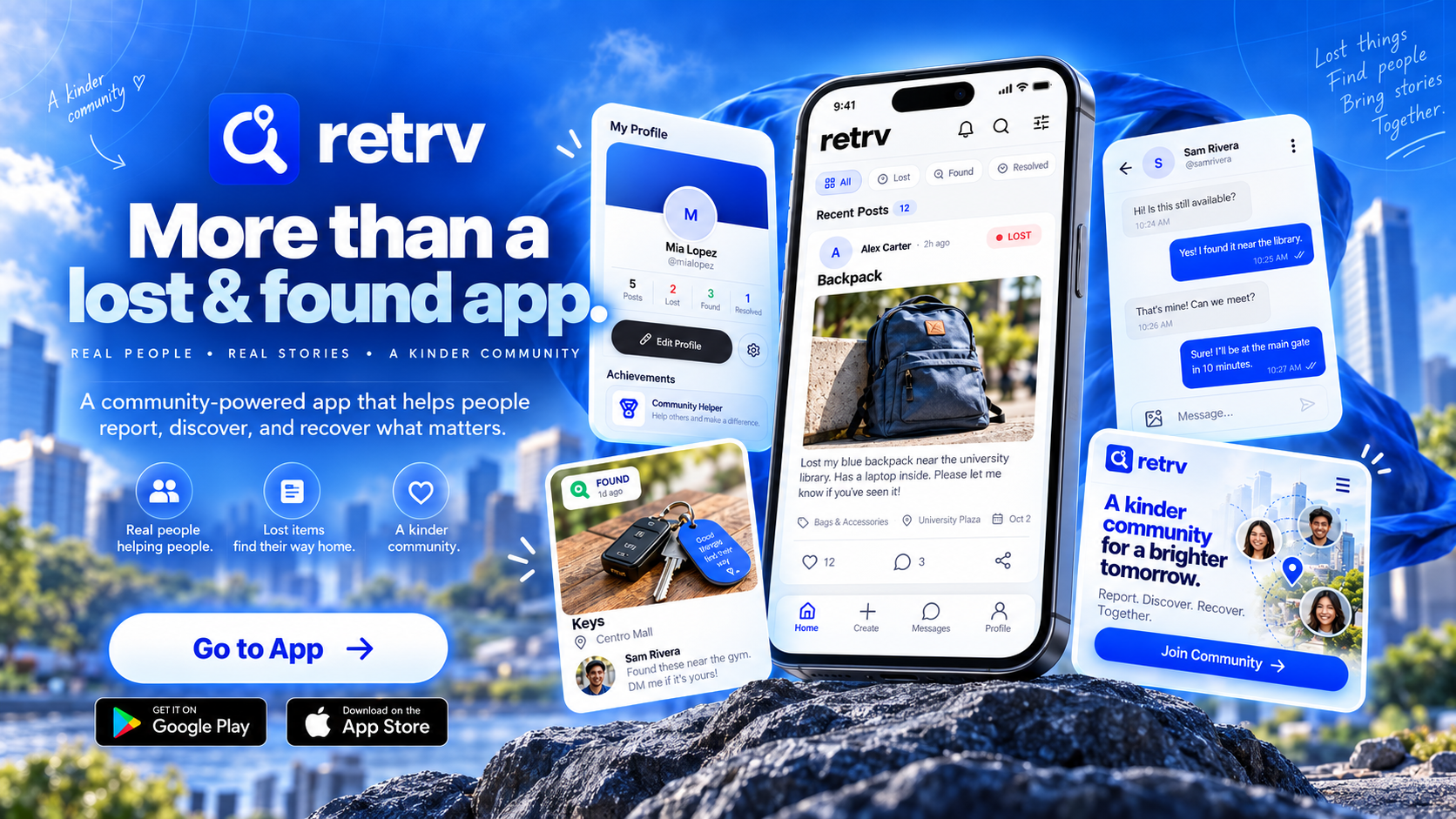
Community-powered Lost & Found mobile platform with realtime messaging and push alerts.
(01) — System Overview
PROJECT
CONTEXT.
A hybrid mobile community application built with Ionic Vue, TypeScript, Capacitor, and Supabase. Transforms isolated lost-item posts into structured, collaborative recovery workflows with location tagging, public discussion threads, Supabase Realtime private chat, community merit awards, UploadThing media handling, and Firebase Cloud Messaging (FCM) push notifications.
The Operational Bottleneck / Problem
Traditional lost-and-found efforts rely on scattered social media posts where updates get lost in comment feeds, private handoff details are hard to coordinate, and helpful community members receive no recognition.
Engineering Solution
Created a dedicated mobile platform that structures the recovery lifecycle into a transparent, collaborative community experience with live chat and push alerts.
(02) — Architecture & Pipeline
SYSTEM
ARCHITECTURE.
Ionic Vue hybrid mobile client interacting with Supabase PostgreSQL for relational data and realtime channels, utilizing UploadThing for media storage and Supabase Edge Functions for FCM push dispatch.
Data & Execution Pipeline
(03) — Technical Focus
ENGINEERING
HIGHLIGHTS.
Social Recovery Workflow Architecture
Structured the entire lost-and-found lifecycle: Structured Report → Public Sightings Discussion → Supabase Realtime Private Coordination → Resolved Handoff → Community Merit Award.
Realtime Private Chat & Notifications
Integrated database-backed direct messaging using Supabase Realtime channels with unread counters and automated mobile push notifications via Firebase Cloud Messaging (FCM).
Community Merit & Reputation Mechanics
Designed a trust system where item owners reward successful recovery helpers with durable merit points and achievement badges displayed on member profiles.
Structured Data Modeling & Categorization
Modeled structured lost/found entries with category hierarchies, location landmarks, coordinate points, and resolution timestamps for precise filtering.
(04) — Implemented Capabilities
CORE
FEATURES.
Structured Lost and Found reporting with photo uploads and geolocation
Public discussion threads and nested replies for community sighting tips
Realtime private messaging powered by Supabase Realtime subscriptions
Push notification pipeline with device tokens and Firebase Cloud Messaging
Community merit system recognizing verified helpful members
Member profiles surfacing lost/found history and achievement badges
Multi-facet search and filtering across categories, status, and locations
Image upload integration using UploadThing with client-side preview
Granular user notification preference management
RLS-enabled database tables and application authorization flows
(05) — Technology Stack
STACK
ARCHITECTURE.
Mobile & Frontend
Backend & Database
Push & Media
Quality & Testing
(06) — Problem Solving
TECHNICAL
CHALLENGES.
Coordinating Realtime State with Mobile Push Delivery
Coupled live Supabase database subscriptions for in-app messaging with serverless Edge Functions that trigger FCM push notifications when recipients are offline.
(07) — Reliability & Governance
SECURITY & TESTING.
Privacy & Security Model
Implements Supabase Authentication, RLS-enabled tables, and application authorization flows to isolate private conversations between participating users.
EXPLORE MORE WORK